
Japanese Honorifics Guide: How to Use -san, -kun, -chan, -sama (Without Being Awkward)
Japanese honorifics like -san, -kun, -chan, -sama are short endings added to names, but they hold a lot of meaning: politeness, closeness, age, status, and sometimes even romance.
Table of Contents
ToggleThis guide explains what each honorific means, when to use it, when not to use it, and how it connects to Japanese names and culture—so you can sound respectful instead of rude or strange.
What Are Japanese Honorifics?
Japanese honorifics are suffixes associated with names and titles to show respect and define the relationship between people.
Examples:
- 田中さん (Tanaka-san) – polite, standard
- 健太くん (Kenta-kun) – casual, often male, younger
- 美咲ちゃん (Misaki-chan) – cute, affectionate
- 神様 (Kami-sama) – God, very respectful
- 先生 (sensei) – teacher/professional title (no name needed)
Honorifics come after the name, unlike in English where “Mr.” or “Ms.” comes before.
The interesting fact is you don’t choose your own honorific. Other people choose it based on how they see you and your relationship.
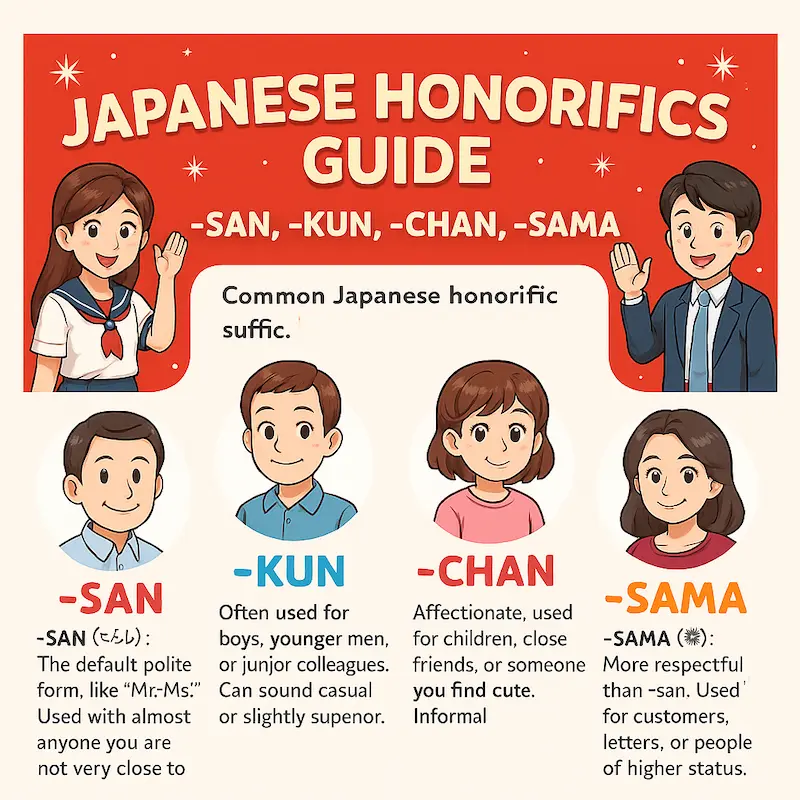
Quick Overview: -san, -kun, -chan, -sama
| Honorific | Typical Use | Formality | Common For |
| -さん | Neutral, polite | Polite/formal | Most people, everyday use |
| -くん | Younger, junior, casual | Casual/semiform | Boys/young men, juniors, close |
| -ちゃん | Cute, affectionate, intimate | Casual | Children, girls, close friends |
| -さま | Very respectful/honorific | Very formal | Customers, gods, VIPs |
How Honorifics Work with Japanese Names
Let’s shed some light on how honorifics work with Japanese names.Japanese Naming BasicsOrder in Japanese: Family name first, given name second山田 太郎 → Yamada TarōOrder in English contexts: Often reversed, but honorifics still attach to the family name most of the time:Yamada-san (more common than Taro-san in many situations)In conversation, Japanese people usually:Use [family name] + honorific in most formal or new relationships.Switch to [given name] + honorific only when closer or if invited to.On a Japanese name generator, you might see full names like “Sato Haruka.”
When using honorifics: “Sato-san,” “Haruka-chan,” etc., depending on context.
-san: The Default Polite Honorific
-さん (san) is the safest and most common Japanese honorific.
Meaning & Feel
- Neutral, polite, and respectful
- Roughly like “Mr.,” “Ms.,” or “Mrs.” but gender-neutral
- Works for almost any adult you’re not extremely close to
When to Use -san
Use -san when you want to:
- Be polite and safe with:
- Co-workers: 鈴木さん (Suzuki-san)
- Neighbors: 田中さん (Tanaka-san)
- Acquaintances: 中村さん (Nakamura-san)
- Talk about people outside your in-group:
- Your teacher: 田中先生 or 田中さん (Tanaka-sensei / Tanaka-san)
- Your child’s friend’s parent: 佐藤さん (Sato-san)
- Address foreigners in Japanese respectfully:
- ジョンさん (John-san)
Examples
- 「山本さん、おはようございます。」
“Good morning, Yamamoto-san.” - 「田中さんはこちらです。」
“Tanaka-san is over here.”
Key Points About -san
- Works with both family names and given names:
- “Mari-san” if you’re on a first-name but still polite basis
- Can also be attached to occupations and roles:
- 店員さん (ten’in-san) – shop staff
- お医者さん (o-isha-san) – doctor (colloquial/polite)
If you’re unsure which honorific to use, -san is almost always correct.
-kun: For Juniors, Boys, and Casual Contexts
-くん (kun) is more casual and often implies junior status, youth, or familiarity.
Meaning & Feel
- Friendly, sometimes slightly “below” the speaker
- Traditionally used for boys or young men
- Also used in workplaces for younger or junior colleagues (even female in some modern contexts)
When to Use -kun
Common uses:
- Teachers to male students
- 「健太くん、発表してください。」
“Kenta-kun, please present.”
- 「健太くん、発表してください。」
- Superiors to junior male employees
- 「田中くん、この資料見ておいて。」
“Tanaka-kun, take a look at these documents.”
- 「田中くん、この資料見ておいて。」
- Between male friends (sometimes)
- A slightly boyish/friendly tone among close friends.
- To female juniors in some companies
- Some workplaces use -kun for both genders to indicate junior status, not gender.
Things to Watch Out For
- Using -kun for someone older or of much higher status can sound disrespectful.
- As a non-native speaker, using -kun with strangers or acquaintances is risky.
- Not usually used by women toward adult male strangers—can feel too familiar.
For learners, -kun is best avoided unless you clearly understand the relationship dynamics—stick to -san. Explore the meanings of Japanese names.
-chan: Cute, Affectionate, and Childlike
-ちゃん (chan) is a diminutive, affectionate honorific.
Meaning & Feel
- Cute, soft, intimate, or childlike
- Expresses affection or closeness
- Can be playful, romantic, or teasing
Common Uses of -chan
- Children and babies
- 子供: 「ゆいちゃん、こっちおいで。」
“Yui-chan, come here.”
- 子供: 「ゆいちゃん、こっちおいで。」
- Girls and close female friends
- Among friends: 「あやちゃん、久しぶり!」
“Aya-chan, long time no see!”
- Among friends: 「あやちゃん、久しぶり!」
- Nicknames and pet names
- Combining parts of the name: まさみ → まーちゃん (Mā-chan)
- Pets: ポチちゃん (Pochi-chan)
- Romantic or flirty tone
- Boyfriends/girlfriends might use -chan with each other’s names.
Risk of Using -chan Incorrectly
Using -chan on the wrong person can sound:
- Patronizing (as if treating them like a child)
- Inappropriately intimate
- Creepy or too forward
Examples of when NOT to use -chan:
- To your boss: ✕「田中ちゃん」
- To someone you just met: ✕「佐藤ちゃん」
- To an older or respected person: ✕「山本ちゃん」
As a foreign speaker, it’s safest to only use -chan for children, pets, and very close friends who are comfortable with it.
-sama: Very Respectful or Formal
-さま (sama) is the highly respectful version of -san.
Meaning & Feel
- Very polite, reverent, or honorific
- Conveys high status or deep respect
When -sama Is Used
- Customers / clients (business etiquette)
- 宮本様 (Miyamoto-sama) in emails, letters, customer records
- 「山田様、こちらへどうぞ。」
“Yamada-sama, this way please.” (very polite)
- Formal letters and writing
- On envelopes:
- 「佐藤 花子 様」 – Ms. Hanako Sato (very polite addressee)
- On envelopes:
- Referring to gods, deities, or spiritual figures
- 神様 (Kami-sama) – God
- お客様は神様です – “The customer is like a god” (common phrase)
- Very high status people or VIPs
- Rare in normal conversation; used in service industries or very formal settings.
Important Nuances
- Using -sama in regular conversation with friends or colleagues can sound:
- Sarcastic
- Comically over-polite
- In anime and manga, -sama can exaggerate respect or show a hierarchical relationship:
- お嬢様 (ojō-sama) – “young lady” of a rich or noble family
For daily speech, -sama is mostly for service language, letters, and special contexts, not ordinary social conversation.
When to Use No Honorific
In Japanese, leaving off honorifics can be more meaningful than adding them.
Situations Where Honorifics Are Dropped
- Very close friends
- Especially among teenagers and young adults once they’re close:
- Just calling someone by their given name: 「健太!」(Kenta!)
- Especially among teenagers and young adults once they’re close:
- Family members
- Many families use:
- First names without honorifics
- Or special family words like お母さん (okaa-san) “Mom”
- Many families use:
- Talking about yourself
- You never add an honorific to your own name:
- ✕「私は田中さんです。」
✔「田中です。」or「私は田中です。」
- ✕「私は田中さんです。」
- You never add an honorific to your own name:
- Talking about your in-group to outsiders
- In polite Japanese, people often omit honorifics for their own family/company members when talking to outsiders to show humility.
Caution with Dropping Honorifics
Dropping honorifics (calling someone just “Taro” instead of “Taro-san”) is called 呼び捨て (yobisute).
- It can show:
- Strong closeness OR
- Strong disrespect
- You should generally wait until the other person invites you to drop the honorific.
Honorifics Beyond -san, -kun, -chan, -sama
To understand Japanese names and honorifics better, it helps to know some other common ones you’ll see:
Title-Based Honorifics
- 先生 (sensei) – Teachers, doctors, lawyers, politicians, artists
- 田中先生 (Tanaka-sensei) – “Professor/Teacher Tanaka”
- 先輩 (senpai) – Senior in school, club, or workplace
- 佐藤先輩 (Sato-senpai)
- 後輩 (kōhai) – Junior (not commonly used as an honorific)
- 社長 (shachō) – Company president
- 田中社長 (Tanaka-shachō)
- 部長 (buchō) – Department manager
- 鈴木部長 (Suzuki-buchō)
These often replace -san and are used with the person’s surname. Explore the meanings of different Japanese names.
Common Mistakes Learners Make with Honorifics
Here are some common mistakes which learners are likely to make while learning honorifics.
1. Using -sama in Normal Situations
- ✕ Calling your friend “Yuki-sama”
- ✕ Calling a random shop clerk “Tanaka-sama”
This sounds like you’re treating them as a deity or high-ranking noble, or you’re being sarcastic.
2. Giving Yourself an Honorific
- ✕「私は山田さんです。」(for yourself)
✔「私は山田です。」or simply「山田です。」
You never add honorifics to your own name.
3. Mixing English Titles and Japanese Honorifics
- ✕ “Mr. Tanaka-san”
- Choose one:
- “Mr. Tanaka” (English style)
- “Tanaka-san” (Japanese style)
4. Using -chan Too Easily
- Using -chan with adults you don’t know is risky.
- It can seem infantilizing, overly familiar, or just strange.
5. Ignoring Relationship and Context
Honorifics are not just “plug and play.” They depend on:
- Age difference
- Social status
- How long people have known each other
- The setting (work, school, family, online, etc.)
If in doubt, start with -san and adjust later if appropriate. You can also check this guide on how to choose a Japanese name.
Lorem ipsum dolor sit amet, consectetur adipiscing elit. Ut elit tellus, luctus nec ullamcorper mattis, pulvinar dapibus leo.

Quick Reference: Which Honorific Should I Use?
If you do not have much knowledge about Japanese honorifics, use this as a guide:
- Strangers, colleagues, polite default → -san
- “Tanaka-san”
- Male student / junior / boy (you’re senior/teacher) → -kun
- “Kenta-kun”
- Child, very close friend, cute nickname → -chan
- “Yui-chan”
- Customer, client, formal letter, deity → -sama
- “Yamada-sama”, “Kami-sama”
And remember:
- When in doubt: -san
- Never use an honorific for yourself
- Don’t switch to -kun/-chan unless there’s real closeness or hierarchy
Lorem ipsum dolor sit amet, consectetur adipiscing elit. Ut elit tellus, luctus nec ullamcorper mattis, pulvinar dapibus leo.
Frequently Asked Questions
What does -san mean in Japanese names?
-San is a neutral, polite honorific added to names. It’s similar to “Mr.” or “Ms.” but can be used for any gender. It shows respect without being overly formal and is the safest choice with most people.
Is -kun only for boys?
Traditionally, -kun is used mainly for boys and young men, especially students and junior male colleagues. However, in modern workplaces, some companies use -kun for young female employees as well, focusing more on junior status than gender. As a learner, it’s more natural to associate it with male or junior use unless you know the specific context.
Can I use -chan for my Japanese friends?
Only if:
- You are already close
- They’re comfortable with it
- The situation is casual
Otherwise, start with -san. If they want you to use -chan, they’ll usually say so or introduce themselves that way (“Call me Yui-chan”).
Why do some characters in anime use no honorifics?
Dropping honorifics (yobisute) can show:
- Very close friendship
- Romantic tension or intimacy
- Disrespect, depending on tone and context
It’s often a storytelling device to show a change in the relationship.